June 20, 2026
Five Proactive Moves to Build Enterprise Cyber Resilience Now
Claude Mythos: Why the Next Six Months Could Define Your Cyber Resilience.
Claude Mythos: Why the Next Six Months Could Define Your Cyber Resilience.
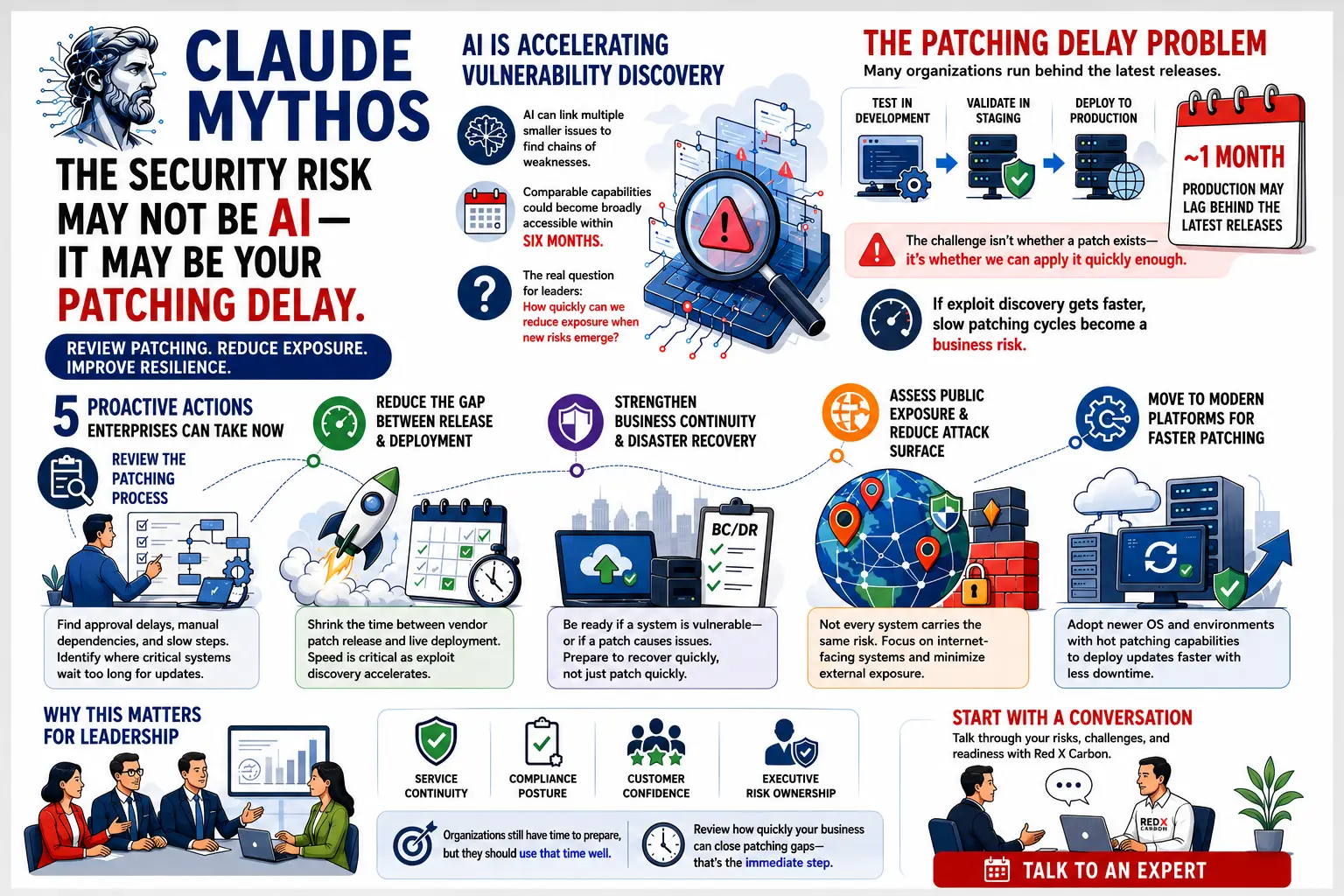
Claude Mythos, Anthropic’s most advanced AI model, is already pushing the boundaries of what’s possible in cybersecurity—demonstrating the ability to autonomously uncover complex weaknesses at a scale and speed that rivals expert human researchers. But what makes it truly disruptive isn’t just its capability—it’s the fact that access is being tightly controlled due to the risks of misuse. That raises a more pressing question for enterprise leaders: if vulnerability discovery is about to accelerate dramatically, is your organization ready to respond just as fast?
AI systems are becoming increasingly capable of identifying chains of software weaknesses by holding a larger context and linking multiple smaller issues together. Concern is not panicking — it is preparedness. There could be a scenario where the comparable capabilities could become broadly accessible within six months, making patch speed and operational readiness far more important than many organizations realize today.
That changes the question for enterprise leaders.
Instead of asking, “Is AI creating new risks?” the better question may be: “How quickly can we reduce exposure when new risks emerge?”
Many organizations still operate with a patching cycle that leaves production systems behind the latest releases. Patches are first tested in development, then staging, and only later in production — often leaving production roughly a month behind. This gap may become much harder to justify if AI-assisted vulnerability discovery accelerates the speed at which attackers can identify exploitable paths.
In other words, the challenge may not be whether a patch exists. The challenge is whether your organization can apply it quickly enough.
This is not about fearmongering. In fact, this is something organizations should be aware of, not something they should be extremely afraid of. The practical focus is on readiness: reviewing patching processes, closing timing gaps, and improving resilience before faster-moving threat scenarios become mainstream.
Here are five areas outlined where organizations should act proactively.
The first step is to examine how patching works today across the business. Where are approvals slowing deployment? Where are manual dependencies creating risk? Where are critical systems waiting too long for updates to move into production? We can help review the patch process as the first area of support.
The second priority is speed. Shrinking the delay between vendor patch release and live deployment is very critical. If exploit discovery gets faster, slow operational cycles become a business risk in their own right.
Operational resilience still matters. We recommended reviewing business continuity and disaster recovery plans, so organizations are ready if a system is vulnerable — or if a patch causes issues after deployment. That means being better prepared to recover quickly, not just patch quickly.
Not every vulnerable system carries the same level of risk. Systems isolated from the internet may be less exposed, while publicly reachable services demand more urgent attention. We can help assess what is externally available and reduce the attack surface wherever possible.
The final area is platform modernization. Newer Windows server environments and hot patching capabilities that can support faster security patch deployment with less downtime. Moving to more current operating system versions can become an important enabler of faster response.
For many organizations, security conversations still happen in technical silos. But patch maturity, exposure visibility, and recovery readiness are not just IT concerns — they affect service continuity, compliance posture, customer confidence, and executive risk ownership.
Organizations still have time to prepare, but they should use that time well. This is time to get ready, and the immediate step is to review how quickly the business can close patching gaps. That makes this a leadership issue, not just a tooling issue.